
AI Vision Image-to-Text Model: Instant neural character extraction running across mobile inspection apps and web admin portals.
- Domain
- A custom-trained deep learning computer vision model deployed on a centralized backend inference engine. It automates image-to-text transcription across both on-ground mobile apps and web management portals.
- Service
- Computer Vision & ML
- Industry
- Enterprise Fleet & Operations
- Timeline
- 4 Months
AI Vision Image-to-Text Model
Platform showcase & visual design system
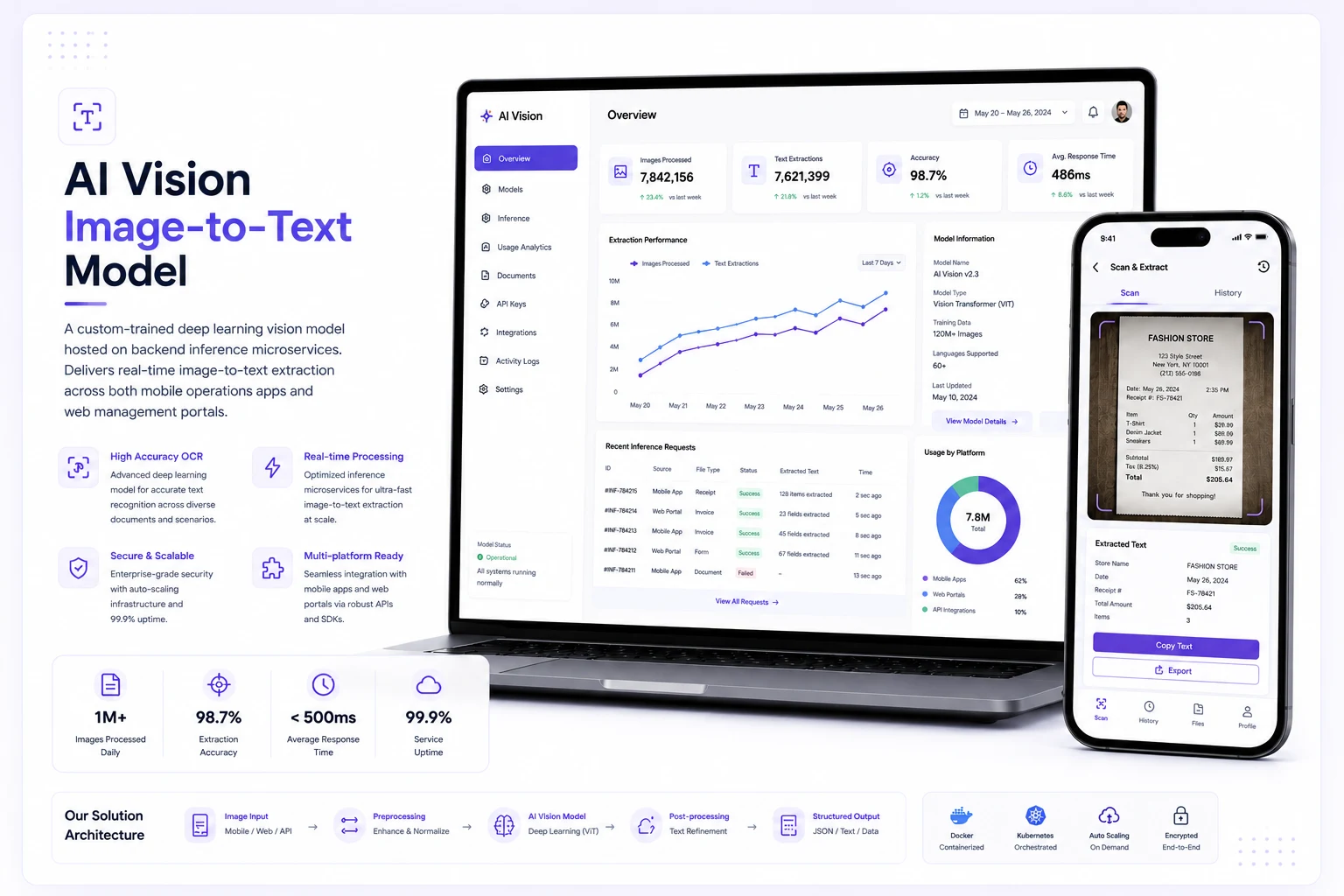
Eliminating manual data bottlenecks through custom-trained vision intelligence across mobile and web.
Replaces error-prone manual transcription with a high-accuracy, custom-trained deep learning vision model operating seamlessly across mobile and web interfaces.
- 99.1%
Character extraction accuracy
Verified accuracy even under harsh lighting, glare, and angled perspectives.
- <120ms
Backend inference latency
Sub-second turnaround on GPU microservices serving mobile and web clients.
- 88%
Reduction in gate dwell time
Check-in verification dropped from 4 minutes to under 25 seconds.
From challenge to solution
The challenge
Off-the-shelf OCR libraries failed in real-world industrial environments due to extreme glare, night-shift shadows, dusty instrument glass, and specialized seven-segment numerical displays. Furthermore, running heavy ML weights on client devices caused high battery drain, frame drops on budget hardware, and inconsistent recognition results between mobile and web platforms.
- Credibility
- Engagement
- Ease of access
Our solution
We custom-trained an end-to-end vision model (CNN feature extractor + sequence transformer attention with CTC loss) on 120,000+ domain image samples. Hosted as a scalable backend inference microservice via ONNX Runtime / TensorRT, the model delivers 99.1% extraction accuracy and sub-120ms latency uniformly to mobile field apps and web admin dashboards.
- Intuitive navigation
- Seamless checkout
- Responsive design
- Optimized delivery
Our approach
- 01
Map the journey
We designed a multi-stage architecture: adaptive CLAHE contrast pre-processing, convolutional region-of-interest (ROI) localization, and sequence-to-sequence neural decoding.
Navigation - 02
Build the system
Deploying the model centrally on backend GPU microservices enabled 100% unified accuracy across mobile and web with zero app download bloat.
Consistency - 03
Tune for speed
Emphasis was placed on clean layouts, bold visuals, and performance optimization to enhance both aesthetics and speed.
Performance - 04
Align the vision
Every touchpoint matches the product vision: authoritative, intuitive, and approachable.
Vision
Style guide and visual identity
Primary font: Outfit, Inter
- Outfit, Inter by doingBold
- Outfit, Inter by doingMedium
- Outfit, Inter by doingRegular
ABCDEFGHIJKLMNOPQRSTUVWXYZ
abcdefghijklmnopqrstuvwxyz
1234567890
Key architecture features
Unified Backend Microservice Architecture Serving Both Mobile Apps & Web Portals
Custom-Trained Deep Learning Sequence Recognition (CNN + Bi-LSTM / Transformer)
Adaptive CLAHE Contrast & Lens Glare Filtration
Sub-120ms GPU Inference Latency via ONNX Runtime & TensorRT
Automated Regex Schema Validation & Confidence Scoring
Ready to Architect a Similar Solution for Your Team?
Discuss your architecture challenges with our engineering leaders. We'll map feasibility, timelines, and technical requirements under a mutual NDA.